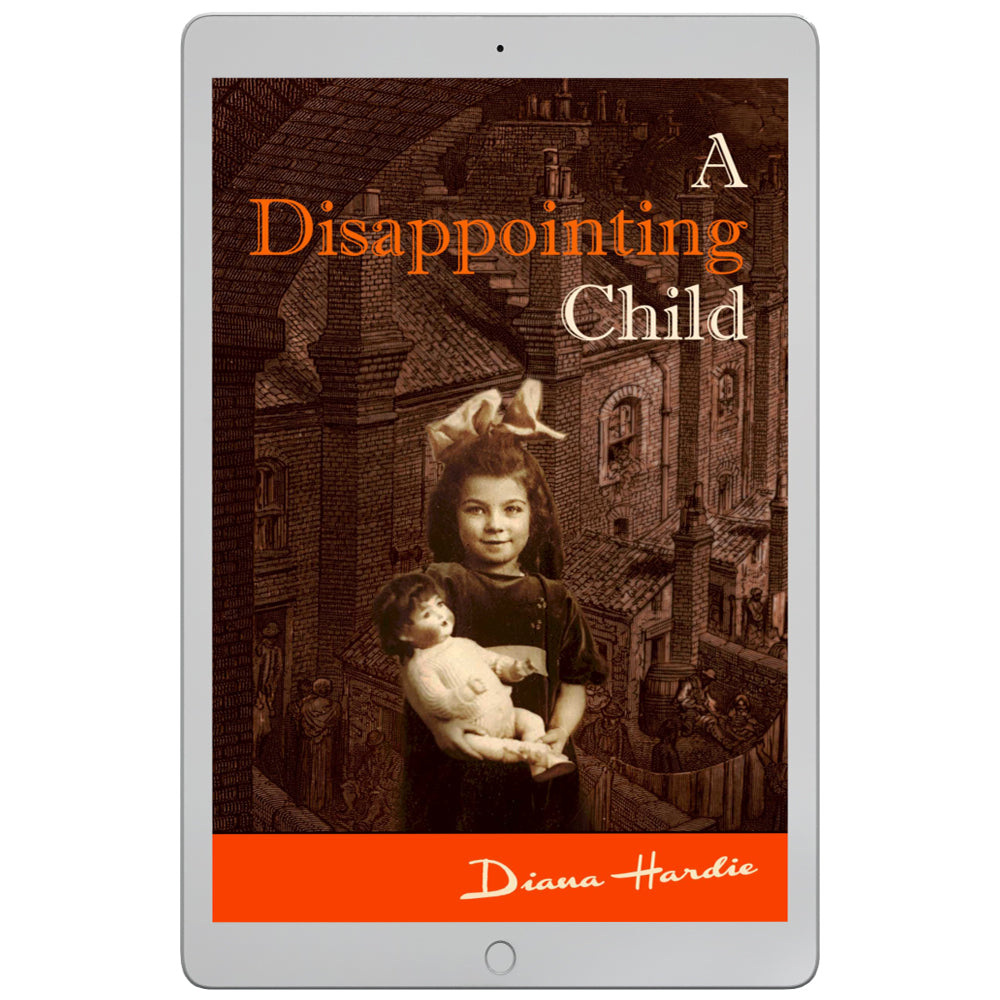

A Disappointing Child (EBOOK)
A Disappointing Child (EBOOK)
Diana Hardie
EBOOK. A PERSONAL MEMOIR
"A Disappointing Child" is a poignant memoir that begins with Diana Hardie’s birth during an air raid in the last year of the First World War. Growing up in the East End of London, Diana navigates a childhood overshadowed by poverty and her mother's volatile outbursts.
With evocative prose, Diana paints a vivid picture of a world in flux, where the optimism of the “swinging twenties” collides with the staid routines of the past.
A scholarship to an exclusive school offers Diana the promise of a better life, but her hopes are dashed when her family decides to emigrate to Australia.
After years of struggling as unwanted “Pommies,” the family are finally deported.
Back in the East End, Diana finds herself a job working in Fleet Street just in time for the Blitz of London.
From the unforgiving Australian Outback to the bomb-ravaged streets of London, Diana's journey is one of unwavering resilience.
"A Disappointing Child" is a testament to the human spirit's capacity to find light in the darkest places. With lyrical prose and raw honesty, Diana Hardie weaves a tale of family, love, and self-discovery that will resonate long after the last page is turned. A truly inspiring read.
THIS EBOOK WILL BE DELIVERED INSTANTLY by EMAIL by BOOKFUNNEL
Share
Read a Sample
Read a Sample
Chapter 1
According to my mother, I was a disappointing child.
She hadn’t wanted a baby. She had been too young to endure such an ordeal, but if she was to be handicapped by a child, she had been confident it would be a son. Certainly not a girl with plain hair and a stubborn little frown.
I was born in 1918 during an air raid in the East End of London, and as a child, I often felt guilty I had upset my mother so much just by being born.
My grandfather tried to explain to me when I was old enough to understand. He told me about the war and said Mother had been afraid, because until then, death had been reserved for soldiers and sailors. It hadn’t come raining down out of the sky on defenceless civilians.
It didn’t help that her relatives were all extremely self-centred. On the night she went into labour, there were twelve family members living in the crowded terrace house my grandmother rented, but when whistles sounded in the street to warn of an air raid, her mother, sisters and brothers, ran out of the house to seek shelter. My fa-ther, a special constable, had been out on duty and only my grandfather stayed with her as she struggled to give birth to me.
At the end of our street, a new Sessions House was being built, and the basement had yet to be fitted out as cells. It was as good an air raid shelter as anyone could find in those days, and whenever the warning whistles blew, people snatched up their chil-dren and ran.
But it was not easy to reach the shelter of the unfinished basement. Women were lowered down sheer walls, crying children were handed down in the darkness to mothers straining on tiptoe to reach them. Often, fear kept them there all night, crowded together in darkness on the cold stone floor.
Looking back, the experience must have been hell for my grandmother. She was, in her own opinion, a reduced gentlewoman. Normally, she did not mix with her neighbours, all of whom she considered coarse and common.
Now and then, one of them would knock on her front door and ask for help. Many could neither read nor write and they would bring official forms to be filled in or letters they needed written. Then she would pen, in her own flourishing hand and her own cryptic words, whatever message was needed.
But neighbours were only allowed inside by appointment. There were formalities to be observed. The parlour on the ground floor had to be unlocked, dusted, and the window opened to freshen the stale air. The brass fender would be polished, and the carpet cleaned, a long process with damp tea leaves scattered across it, then carefully brushed off on hands and knees.
Of course, Grandmother never undertook any of these menial tasks herself. In bet-ter days, she would have had a maid, but in my memory, times had changed. She had slipped a long way down the social scale, although she never acknowledged it, but she had plenty of daughters. There was always one she could keep at her beck and call.
I rarely went into the parlour. From my earliest days, I would not have ventured in unless invited. The parlour was for visitors. Now and then, on a Sunday evening, it would be opened for a brief family gathering and Uncle Eric or Uncle Ernie would play the latest music-hall songs on the candle-stick fronted piano while the rest of the family sang at the top of their voices, much to the irritation of the neighbours.
I loved watching Uncle Ernie play. He couldn’t read music and had never had a lesson in his life, but he played the piano with his whole body. His fingers hammered the keys while his elbows flapped up and down at his sides in time with the music. His head wagged, his feet tapped, and his skinny body shivered with the effort until he burst into such a fit of coughing, he was forced to retire and let Uncle Eric take over.
I felt sorry for Uncle Eric. Most people did. The youngest boy in the family, shy and weak-chested, my grandmother dominated him completely. While my grandfather looked on drink as an evil, she liked a glass or two of stout and enjoyed going to the pub at the corner of the street. Anything, she said, was better than sitting opposite my grandfather every evening as he read the bible.
She never demeaned herself by going into the public bar where the language was ripe and men spat freely on the sawdust-covered floor.
No, she was a lady. She went to the private bar, but even there, a woman was looked down upon if she was not accompanied by a male. So, from the day Eric could be passed off as fourteen, he went to the pub with his mother. He was an alcoholic long before he was an adult.
*****
No one entered the parlour without my grandmother’s permission. It was not pos-sible, as she wore the key on a string around her neck. The parlour was a shrine, cut off from the rest of the house, sacred to the style of life she felt befitted her social sta-tus.
Her own grandmother had been a rich woman who owned the Blackmore Estates near Bristol. When her daughter bore an illegitimate child, the old lady tossed her out but kept the child. In her judgement, the baby was an innocent victim and should not be made to suffer.
She christened the baby Annie and brought her up in a life of luxury. The big house and the surrounding estates with their farms and tenants were her home. She was educated at the famous Red Maid School in Bristol and she wanted for nothing. In return, she was expected to behave as a well-bred young lady of her day.
But Annie had other ideas, the main one being to escape from the strict control of her grandmother, and do as she pleased. At seventeen, she ran away to London, plan-ning to find her mother. She succeeded, but her mother was living in squalor with a sailor and had a brood of other illegitimate children. She turned Annie away, no doubt influenced by the fact that, now and then, her mother sent money to ensure her other children didn’t starve. There would be no more handouts if she was found to be har-bouring Annie.
And so my grandmother found herself alone in a strange city. Too proud to go back to Bristol, she found work serving in a pie shop near the London docks. At that time, dockers queued daily, hoping to be offered work. They were a rough lot and groups of them crowded into the pie shop to buy food and ogle the new girl with her expensive clothes and la-de-da accent.
Among them, one stood out from the rest.
He wore the same work-stained clothes as his companions, but his shoulders were broad and his manner confident. Ernest Leopard was a natural leader, and if anyone disputed the fact, a swift fight always ended in his favour. He might have had blonde curls, bright blue eyes and a helping of French blood, a combination that attracted every female eye, but at heart he was a cockney. Life had not been kind to him, but he had learned to seize the few opportunities it presented.
Annie fell for his charms at once. Within weeks, she was pregnant. They married quickly and moved into a cramped backroom near the docks. Annie had been ada-mant. One day, she was sure, her grandmother would find her, and when she did, she was determined not to admit to the same plight as her mother. Marriage, at least, was respectable.
The baby was barely a week old and Annie was alone with it when one of Ern-est’s friends came looking for him. The young fellow was drunk and ridiculed Annie when she tried to send him away. What the hell was she so cocky about? Had Ernest told her how much he had won by getting his leg over her? His mates had clubbed together and bet him five pounds he couldn’t get Miss High-and-Mighty into bed.
Poor Ernest. He won his five pounds, but he paid for the rest of his life. From that moment on, my grandmother hated my grandfather.
Ernest was an honest man and when Annie questioned him, he admitted the bet but told her he had married her, not because she had forced him, but because he loved her.
It made no difference. She never forgave him.
Months later, a letter did arrive for Annie, after her grandmother’s solicitor had managed to trace her, but by then, she was pregnant again.
The letter said her grandmother was gravely ill and asked Annie to return to Bris-tol as quickly as possible. Before Annie could scrape together enough money for the fare to Bristol, she received another letter. Her grandmother was dead.
Pregnant, and with a sickly child, Annie did not make it back to Bristol in time for the funeral, but she was certain her grandmother had wanted them to be reconciled. Perhaps she had mentioned her in her will? Perhaps the old lady had even named her as her heir?
A few days later, sitting in the drawing room of the magnificent house that had been her childhood home, Annie faced her grandmother’s solicitor. When she ques-tioned him, the old man shook his head. He had searched the house from top to bot-tom but had found no trace of a will.
Annie knew her grandmother kept important papers in a secret drawer in the back of an old clock in her study, but when she looked, the back of the clock had been prized off and the drawer was empty.
If my great-great grandmother did make a will, it was never found.
The solicitor warned Annie she would need to prove her identity if she was to make a claim on the estate. If she could not not, and no other claimant came forward, the property and all her grandmother’s money would go into Chancery and be passed to the government.
Annie had no birth certificate. She had nothing to prove her existence, or even to prove her mother’s existence. When her grandmother had tossed her daughter out in disgust, she had burned every paper relating to her.
There was nothing my grandmother could do but return to the mean little room near the docks, but she never forgot the life she felt should have been hers. Her in-stincts told her that her grandmother had forgiven her and had left a will that would have given her back the life of a lady, but she had no proof and no money to hire so-licitors to search for it.
Annie and Ernest had twenty-three children, twelve of whom she buried at birth, yet she never forgave him and she never stopped hating him.